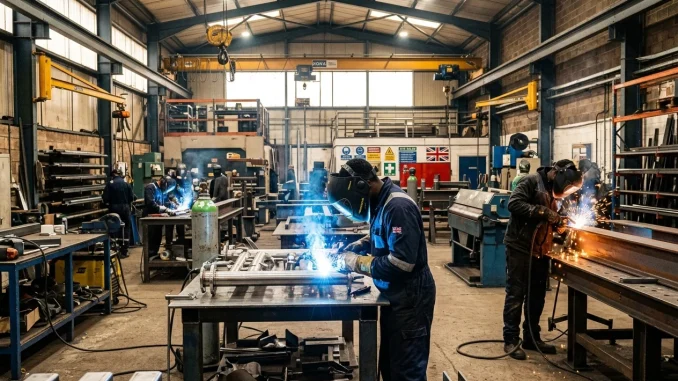
Here is a fact that every skilled welder outside the United Kingdom needs to know: welding trades under SOC code 5213 are officially listed on both the UK Immigration Salary List (ISL) and the Temporary Shortage Occupation List — meaning the British government has formally recognised that domestic supply cannot meet demand, and international recruitment is actively supported. According to Jobsite, there are currently 832 live welder vacancies across the UK, while Jooble lists over 5,500 sponsorship-related welder positions.
If you are a Nigerian, African, or international welder searching for a genuine pathway to working and living in the United Kingdom, welder jobs in UK with visa sponsorship 2026 represent one of the most tangible and well-supported skilled trade opportunities available right now. Unlike many other medium-skilled occupations that lost eligibility after the July 2025 immigration rule changes, welding trades retained their sponsorship eligibility specifically because they appear on the government’s shortage and salary lists.
The salary range is compelling. According to data from Glassdoor, Reed, Indeed UK, and CV-Library, UK welders earn between £28,000 and £55,000 per year depending on their specialism, experience level, and location — with offshore, pipe, and nuclear welders commanding significantly higher rates. When combined with NHS healthcare access, workplace pension contributions, overtime opportunities, and a clear 5-year pathway to permanent residency, welding in the UK offers far more than a payslip.
This comprehensive guide delivers everything you need: the complete salary breakdown by specialism and region, which employers are actively sponsoring, exact qualification requirements, detailed visa rules including critical 2025 and 2026 changes, a step-by-step application process, the best job boards, common mistakes to avoid, and answers to every critical question. Whether you are reading this from Lagos, Accra, Nairobi, Johannesburg, Manila, or anywhere else in the world, this is your definitive, research-backed roadmap.
Why the UK Is Hiring Welders in 2026
A Structural Shortage Across Construction, Manufacturing, and Energy
The United Kingdom is in the midst of a multi-decade infrastructure investment cycle that has created sustained, high-level demand for skilled welders that the domestic workforce simply cannot fill. The construction, manufacturing, shipbuilding, energy, and defence sectors are all competing for the same limited pool of qualified welding professionals.
According to UK Visa Jobs, welders and skilled metal workers rank among the top 10 most in-demand jobs with visa sponsorship in 2026, with the report confirming that “the UK construction and manufacturing sectors continue to face shortages of qualified welders and skilled metal workers.”
The drivers of this demand are enormous and long-term:
- Major infrastructure projects — including nuclear energy construction at Hinkley Point C and Sizewell C, offshore wind farm expansion across the North Sea, and ongoing rail and road infrastructure upgrades requiring structural steel welding
- Defence and shipbuilding — Babcock International’s submarine maintenance programmes at Devonport and Rosyth, and Navantia UK’s acquisition of Harland & Wolff’s Belfast shipyard in January 2025, have created hundreds of welder positions in naval construction
- Manufacturing and fabrication — the UK’s advanced manufacturing sector requires welders across automotive, aerospace, heavy engineering, and steel fabrication
- An ageing domestic workforce — many experienced UK welders are reaching retirement age, with insufficient numbers of young workers entering welding apprenticeships to replace them
- Energy transition — the UK’s commitment to net zero is driving massive demand for welders in renewable energy infrastructure, including offshore wind turbines, hydrogen pipelines, and nuclear decommissioning
Government Recognition Through the Immigration Salary List
The UK government has formally recognised this shortage. According to the official GOV.UK Immigration Salary List, welding trades (SOC 5213) — specifically high integrity pipe welders with 3 or more years’ experience — are listed on the Immigration Salary List UK-wide, with a removal date of 31 December 2026. This listing provides reduced salary thresholds for visa sponsorship.
Additionally, Hunt UK Visa Sponsors confirms that welding trades are also on the Temporary Shortage Occupation List, meaning welders “may qualify with a lower salary and get extra immigration points.”
This dual listing — on both the ISL and the Temporary Shortage List — places welding in an exceptionally strong position for international recruitment.
Visa Sponsorship: What It Means for You
Understanding Visa Sponsorship in Simple Terms
Visa sponsorship means a UK employer with a valid Sponsor Licence from the Home Office agrees to legally support your right to work in the United Kingdom. In practical terms, this means the employer issues you a Certificate of Sponsorship (CoS) — a unique digital reference number — which you use to apply for a Skilled Worker Visa.
How Welding Fits Into the Current Visa System
This is where understanding the rules becomes critical. The July 2025 immigration rule changes restructured Skilled Worker visa eligibility by skill level:
- Higher Skilled roles (RQF Level 6+) — remain fully eligible for sponsorship without restrictions
- Medium Skilled roles (RQF Level 3–5) — can now only be sponsored if the occupation is on the Immigration Salary List or the Temporary Shortage Occupation List, or the worker already held Skilled Worker leave before July 2025
According to GOV.UK’s eligible occupations list, welding trades (SOC 5213) are classified as Medium Skilled (RQF Level 3+). However, because welding appears on both the ISL and the Temporary Shortage List, it retains full sponsorship eligibility despite being a medium-skilled occupation.
This is critically important. Many other medium-skilled trades lost their sponsorship eligibility in July 2025. Welding survived because the government recognises the shortage is genuine and acute.
Who Qualifies
To qualify for a sponsored welding position, you need:
- A job offer from a UK employer with a valid Sponsor Licence
- The role must meet the salary threshold — the going rate for SOC 5213 is £34,900, but the general Skilled Worker threshold is £41,700, so sponsors must typically pay whichever is higher
- For high integrity pipe welders on the ISL, the standard rate is £34,900 and the lower rate is £29,500
- English language proficiency at CEFR Level B2 (from 8 January 2026 — raised from B1)
- A valid Certificate of Sponsorship from your employer
What the Employer Typically Covers
- Sponsor Licence fee — one-time cost for the company
- Certificate of Sponsorship fee — per worker
- Immigration Skills Charge — £364–£1,000 per year depending on company size
The worker is typically responsible for:
- Visa application fee — £719 (up to 3 years) or £1,420 (more than 3 years)
- Immigration Health Surcharge (IHS) — £1,035 per year
- Financial maintenance — £1,270 in savings (unless employer certifies this)
Average Welder Salary in UK in 2026
Welder pay in the UK varies significantly based on specialism, experience level, location, and industry sector. Here is a comprehensive breakdown drawing from multiple authoritative salary sources.
Overall Salary Data
| Source | Average/Median Salary | Notes |
|---|---|---|
| ONS ASHE 2025 | £32,500 median (basic, full-time) | Official government data; 4.1% YoY increase |
| Glassdoor | £30,000 average base | Range £25,000–£37,000 (25th–75th percentile) |
| Indeed UK | £19.23/hour (~£40,000/year) | Based on 3,800 salary reports |
| Reed | £36,797 average | Range £35,097–£38,594 |
| Jooble | £35,430 average | Data as of June 2026 |
| HighestPayingJobs | £35,600 average (2026 YTD) | Based on 159 jobs counted Jan–Jul 2026 |
Salary by Experience Level
According to CV-Library and Glassdoor:
| Experience Level | Typical Annual Salary | Typical Hourly Rate |
|---|---|---|
| Trainee / Apprentice | £18,000 – £22,000 | £9 – £11/hr |
| Entry-Level Qualified Welder | £22,000 – £27,000 | £11 – £14/hr |
| Experienced Welder (3–9 years) | £27,000 – £36,000 | £14 – £19/hr |
| Senior / Specialist Welder | £35,000 – £45,000+ | £18 – £23/hr |
| Offshore / Nuclear / Underwater | £50,000 – £75,000+ | £25 – £35+/hr |
Salary by Specialism
Different welding processes and sectors command different premiums. Based on CV-Library data:
| Specialism | Typical Salary Range | Notes |
|---|---|---|
| General MIG Welder | £23,000 – £28,000 | Most common; competitive rates |
| TIG Welder | £26,000 – £40,000+ | Higher precision commands premium |
| Welder/Fabricator | ~£33,000 | Combines welding with fabrication |
| Coded Welder | £32,000 – £36,000 | BS EN ISO 9606 certification required |
| Pipe Welder | £33,000 – £45,000 | High-integrity work; ISL eligible |
| Structural Steel Welder | £35,000 – £42,000 | Major construction projects |
| Offshore/Rig Welder | £35,000 – £80,000+ | Rotation schedules with hazard uplift |
| Underwater Welder | £35,000 – £70,000+ | Combined diving and welding skills |
Salary by UK Region
According to CV-Library and Reed:
| Region | Typical Annual Range |
|---|---|
| London | £30,000 – £40,000+ |
| South East | £28,000 – £38,000 |
| Midlands | £26,000 – £36,000 |
| North West & Yorkshire | £25,000 – £35,000 |
| North East | £25,000 – £34,000 |
| Scotland | £25,000 – £36,000+ (higher around offshore/shipbuilding) |
| Wales | £24,000 – £32,000 |
| Northern Ireland | £24,000 – £32,000 |
The highest-paying locations according to Reed include Southampton (£70,924 average), Barrow-in-Furness (£60,605), and Wolverhampton (£60,265) — all linked to defence, marine, or heavy engineering projects.
Visa Sponsorship Salary Thresholds
According to Hunt UK Visa Sponsors:
- Going rate for SOC 5213: £34,900/year (£17.90/hr)
- General Skilled Worker threshold: £41,700/year
- Sponsors must pay whichever is higher — so most sponsored welder roles need to pay at least £41,700 unless the ISL or new entrant discount applies
- ISL standard rate (high integrity pipe welders): £34,900
- ISL lower rate: £29,500
- New entrant rate (under 26 or recent graduate): £29,500
Benefits Package
UK welding positions typically include:
- Workplace pension — employer contributions of 3%+ (auto-enrolment minimum)
- NHS healthcare access — free at point of use for IHS-paying visa holders
- 28 days paid annual leave (including bank holidays — statutory minimum)
- Overtime opportunities — time-and-a-half or double time is common in manufacturing and construction
- Shift allowances — 20%–30% uplift for night and weekend shifts
- Life insurance and sick pay — varies by employer
- Some employers provide relocation packages including temporary accommodation, travel assistance, and settling-in support
- Tool allowances and PPE provided
- Training and upskilling — many employers fund additional welding certifications
Top Employers Currently Sponsoring Welders in UK
The following major UK employers hold Home Office Sponsor Licences and are actively recruiting welders, many with visa sponsorship. You can verify any employer’s status on the official Register of Licensed Sponsors.
1. Babcock International
Babcock International is one of the UK’s largest defence, engineering, and nuclear services companies. With major operations at Devonport Royal Dockyard (Plymouth) and Rosyth (Fife, Scotland), Babcock is at the heart of the UK’s submarine maintenance and construction programmes. According to Hunt UK Visa Sponsors, Babcock currently advertises welder roles with salaries up to £53,599 at Rosyth, working on tactical missile tube assemblies for the Combined Deterrent Programme. Babcock also advertises First Line Manager Welder roles at Devonport with salaries of £33,900–£48,800.
[Apply at Babcock International]
2. Navantia UK
Navantia UK is a subsidiary of Navantia SA, a Spanish state-owned shipbuilding company with over 300 years of history. In January 2025, Navantia UK completed the acquisition of Harland & Wolff, the historic Belfast shipyard. They are now actively recruiting welders for naval shipbuilding and defence projects across Northern Ireland. Navantia UK holds a valid Sponsor Licence and is listed on Hunt UK Visa Sponsors with active welder vacancies.
[Apply at Navantia UK]
3. Balfour Beatty
Balfour Beatty is one of the UK’s largest infrastructure groups, operating across construction, support services, and infrastructure investments. With over 26,000 employees, Balfour Beatty is involved in major projects including highways, rail, utilities, and commercial construction. They currently advertise welder positions in their steel fabrication facilities and hold an active Sponsor Licence. According to Hunt UK Visa Sponsors, their Hereford facility is actively hiring welding operatives.
[Apply at Balfour Beatty]
4. Bilfinger UK
Bilfinger UK is a leading engineering and maintenance provider operating across the chemical, petrochemical, nuclear, oil & gas, pharmaceuticals, power, and renewables sectors. They specialise in asset management services throughout all lifecycle phases. Bilfinger is currently recruiting welders for the Hinkley Point C nuclear construction project in Bridgwater, Somerset — one of the UK’s largest infrastructure projects. They hold an active Sponsor Licence.
[Apply at Bilfinger UK]
5. Laker Vent Engineering
Laker Vent Engineering is a leading mechanical contractor in the engineering construction industry, specialising in the installation of highly regulated process piping systems for blue-chip clients across power, energy, pharmaceutical, and chemical sectors. They currently advertise pipe welder roles in Ayrshire, Scotland, with opportunities across the North West, North East, and South West. This type of role — piping welding — is directly aligned with the high integrity pipe welder category on the Immigration Salary List.
[Apply at Laker Vent Engineering]
6. Swissport GB
Swissport GB operates across major UK airports providing ground handling, cargo, and engineering services. Their workshop teams require fabricator/welders to maintain ground support equipment fleets. Currently advertising at Stansted Airport with a Sponsor Licence in place. While primarily an aviation services company, Swissport offers stable, year-round welding employment.
[Apply at Swissport GB]
7. GE Aviation Systems (now GE Aerospace)
GE Aviation Systems is a global aerospace leader with manufacturing facilities in Scotland. They currently recruit skilled welders with apprenticeship qualifications, and their job listings explicitly state: “Applications from job seekers who require sponsorship to work in the UK are welcome and will be considered alongside all other applications.” This is a clear, employer-stated willingness to consider visa sponsorship.
[Apply at GE Aerospace]
Important Note: According to Hunt UK Visa Sponsors, the top nationalities sponsored for welder roles in the UK are: Philippines (207), South Africa (34), India (27), Zimbabwe (13), and Malaysia (10) — confirming that international recruitment for welding is established and ongoing.
Requirements and Qualifications
To secure a welder job in the UK with visa sponsorship, you must meet several key requirements. Understanding these in advance allows you to prepare effectively and present the strongest possible application.
Minimum Education
- A secondary school certificate (GCSE equivalent) is the baseline requirement
- A welding diploma, certificate, or vocational qualification significantly strengthens your application
- According to GOV.UK’s SOC 5213 description, “Entrants typically possess GCSEs/S grades. Training is typically by apprenticeship incorporating practical experience and technical training.”
- NVQs/SVQs at Levels 1, 2, and 3 in welding and fabrication are the standard UK vocational qualifications
- A bachelor’s degree is not required — welding is a skilled trade where practical competence and certifications matter more than academic qualifications
Welding Certifications and Coding
This is the most critical area for welder applications. According to GOV.UK, “Welders must normally pass a competency test in the particular type of welding to be carried out.”
Key certifications that UK employers value:
- BS EN ISO 9606-1 — the European standard for welder qualification testing (steel and aluminium)
- ASME IX — American welding standard, widely recognised in the UK energy sector
- AWS D1.1 — American Welding Society structural welding code
- Coded welder certificates for specific processes: MIG (GMAW), TIG (GTAW), MMA/Stick (SMAW), Flux Core (FCAW)
- CSWIP (Certification Scheme for Welding and Inspection Personnel) — highly valued in the UK
- Certifications in specific positions: 1G, 2G, 3G, 4G, 5G, 6G (with 6G being the most advanced pipe welding position)
For the Immigration Salary List category specifically, the role must be a high integrity pipe welder with 3 or more years’ related on-the-job experience that was not gained through working illegally, as stated on GOV.UK.
Work Experience
- Minimum 1 to 3 years of professional welding experience is typically expected
- For ISL-eligible pipe welding roles: minimum 3 years of verifiable experience
- Experience in relevant sectors: construction, manufacturing, shipbuilding, oil & gas, energy, fabrication
- Ability to read and interpret engineering drawings and blueprints
- Experience with quality inspection processes and defect identification
- Knowledge of health and safety procedures in industrial environments
Language Requirements
- The Skilled Worker Visa English language requirement is currently at CEFR Level B1
- From 8 January 2026, the requirement increases to CEFR Level B2 (approximately IELTS 5.5–6.5)
- Approved tests include: IELTS for UKVI, PTE Academic, LanguageCert, and other SELT-approved tests
- Exemptions apply if you are a national of a majority English-speaking country (including Nigeria, Ghana, Kenya, South Africa, and others) or hold a degree taught and assessed in English

Health and Safety Certifications
UK construction and industrial sites require specific safety qualifications:
- CSCS Card (Construction Skills Certification Scheme) — required for most UK construction sites
- CCNSG Safety Passport — required for oil, gas, and petrochemical sites
- Hot Works Permit awareness
- Manual Handling training
- Working at Height training (for structural welding)
- Confined Spaces training (for pipe welding in restricted environments)
While some of these can be obtained after arrival in the UK, having equivalent safety training from your home country demonstrates professionalism and preparedness.
Step-by-Step: How to Apply for Welder Jobs in UK with Visa Sponsorship
Follow these seven detailed steps to navigate the application process effectively.
Step 1: Assess Your Skills and Obtain Recognised Certifications
Before applying, ensure your qualifications meet international standards:
- Identify your welding specialism — are you strongest in MIG, TIG, MMA, or pipe welding? UK employers recruit for specific processes, so clarity on your specialism is essential
- Obtain or update your coding certificates — BS EN ISO 9606, ASME IX, or AWS certifications are internationally recognised and dramatically strengthen your application
- If you are a pipe welder with 3+ years’ experience, you may qualify under the Immigration Salary List, which provides a lower salary threshold and extra immigration points
- Document your experience with photographs of completed welds, procedure records, and quality inspection reports — UK employers increasingly request visual portfolios
- If possible, obtain a 6G pipe welding certification — this is the gold standard and qualifies you for virtually all welding positions
Step 2: Prepare a UK-Standard CV and Supporting Documents
Your CV must be tailored to UK industry expectations:
- Format: Clean, professional, UK English, maximum 2 pages
- Lead with your welding certifications and coding qualifications — list every process, material, and position you are coded in
- Detail your sector experience — construction, shipbuilding, oil & gas, manufacturing, energy
- List specific projects you have worked on, including scale, materials, and quality standards met
- Include your safety certifications (CSCS equivalent, safety passports, first aid)
- Provide two professional references from supervisors or project managers who can attest to your welding competence
- Prepare a clear skills matrix showing your proficiency across different welding processes, materials (mild steel, stainless steel, aluminium, duplex), and positions
Step 3: Research and Target Licensed Sponsor Employers
Not every UK employer can sponsor foreign workers. Focus strategically:
- Check the official Register of Licensed Sponsors — filter for construction, manufacturing, and engineering companies
- Target the major employers listed in this article — Babcock, Navantia UK, Balfour Beatty, Bilfinger, Laker Vent Engineering, and GE Aerospace all hold active licences
- Use Hunt UK Visa Sponsors — this platform specifically lists welder jobs from companies with valid Sponsor Licences
- Focus on defence, nuclear, offshore energy, and shipbuilding sectors — these employers are the most active in sponsoring international welders
- Join welding and engineering groups on LinkedIn and Facebook where international workers share information about sponsoring employers
Step 4: Submit Targeted, High-Quality Applications
- Apply directly through employer career pages and through specialist job boards
- Tailor your application for each specific role — demonstrate knowledge of the company’s projects and the specific welding processes required
- In your covering letter, clearly state your visa status, welding certifications, years of experience, and willingness to relocate
- Emphasise any experience with UK or European welding standards (BS EN ISO, ASME) rather than solely domestic standards
- Apply to at least 20 to 30 employers — sponsored roles in skilled trades are competitive
- Consider using specialist industrial recruitment agencies that work directly with engineering companies on visa-sponsored placements
Step 5: Excel in the Assessment and Interview Process
UK engineering employers take technical assessment seriously:
- Welding tests are standard — expect to perform practical welding demonstrations in your coded processes and positions
- Be prepared to weld test pieces that will be visually inspected and potentially X-ray or ultrasonic tested for quality
- Video interviews are standard for international candidates — ensure stable internet and professional presentation
- Demonstrate knowledge of UK health and safety standards, including COSHH, risk assessments, and method statements
- Show familiarity with quality management systems (ISO 9001, ISO 3834 for welding quality)
- Ask informed questions about induction programmes, additional coding opportunities, and career progression
Step 6: Receive Your Certificate of Sponsorship and Apply for Your Visa
Once an employer decides to hire you:
- The employer assigns a Certificate of Sponsorship (CoS) — a unique digital reference
- Apply for your visa up to 3 months before your start date
- Apply online through the UK Government visa application portal
- Pay the visa application fee — £719 (up to 3 years) or £1,420 (more than 3 years)
- Pay the Immigration Health Surcharge — £1,035 per year
- Submit biometric information at a visa application centre in your country
- Provide supporting documents: CoS, passport, English language evidence, criminal record certificate, bank statements
- Processing time: typically 3 to 8 weeks (priority service available at £500 for 5 working days)
Step 7: Relocate and Launch Your UK Welding Career
Upon visa approval:
- Arrange travel to the United Kingdom
- Secure accommodation — many industrial employers in remote locations offer site accommodation or lodging allowances
- Collect your Biometric Residence Permit (BRP) within 10 days of arrival
- Register with a GP for NHS healthcare access
- Open a UK bank account (Monzo, Starling, HSBC work well for newcomers)
- Complete site induction, safety training, and any required UK-specific certifications (CSCS card, safety passport)
- Begin building your career toward Indefinite Leave to Remain (ILR) after 5 continuous years
RELATED ARTICLES:
- Teacher Jobs in UK with Visa Sponsorship 2026 – Salary £28,000 – £55,000 | How to Apply
- Chef Jobs in UK with Visa Sponsorship 2026 – Salary £28,000 – £55,000 | How to Apply
- Warehouse Operative Jobs in UK with Visa Sponsorship 2026 – Salary £28,000 – £55,000 | How to Apply
Best Job Boards to Find Sponsored Welder Jobs in UK
1. Hunt UK Visa Sponsors (huntukvisasponsors.com)
Hunt UK Visa Sponsors is the single most important resource for international welders. It lists only jobs from employers with verified Home Office Sponsor Licences, meaning every listing represents a genuine sponsorship opportunity. You can filter specifically for welder roles under SOC 5213 and see salary data, company information, and live vacancies. This should be your first stop, every day.
2. Indeed UK (uk.indeed.com)
Indeed UK is the UK’s largest general job search engine and lists numerous welding positions with visa sponsorship. Use search terms like “welder visa sponsorship” combined with your specialism (MIG, TIG, pipe welder). Indeed also displays salary data, company reviews, and allows you to set up instant job alerts so you are notified the moment new sponsored roles are posted.
3. Totaljobs (totaljobs.com)
Totaljobs currently lists 834 visa-sponsorship-related welder vacancies across the UK. Totaljobs is one of the UK’s largest job boards and provides detailed salary information, company profiles, and regional filtering. You can search by location, salary range, and contract type to find the most relevant opportunities.
4. Jooble UK (uk.jooble.org)
Jooble aggregates over 5,500 sponsorship-related welder vacancies from multiple job boards and employer websites. This meta-search engine saves time by combining listings from Indeed, Totaljobs, Reed, LinkedIn, and direct employer career pages into a single searchable database.
5. LinkedIn (linkedin.com)
LinkedIn is essential for networking with UK engineering recruiters, fabrication companies, and industrial project managers. Create a compelling profile showcasing your welding certifications, project portfolio, and sector experience. Connect with UK-based welding inspectors, fabrication managers, and recruitment consultants. Many specialist and senior welding roles are posted exclusively on LinkedIn, and recruiters actively search for candidates with specific coding qualifications.
6. Glassdoor UK (glassdoor.co.uk)
Glassdoor provides detailed salary data, employer reviews, and interview insights from welders currently working in the UK. Before applying to any company, check their Glassdoor profile for worker satisfaction, management quality, and interview process details. This intelligence is invaluable for preparing applications and negotiating compensation.
Common Mistakes to Avoid
Pursuing welder jobs in the UK with visa sponsorship requires careful strategy. Avoid these critical errors:
- Ignoring the difference between general welding and ISL-eligible pipe welding. The Immigration Salary List specifically covers “high integrity pipe welders” with 3+ years’ experience — not all welding roles. If you are a pipe welder meeting this criteria, you benefit from a reduced salary threshold of £34,900 (standard rate) or £29,500 (lower rate). If you are a general MIG welder, the standard Skilled Worker threshold of £41,700 applies. Understanding this distinction is crucial for targeting the right roles and managing salary expectations.
- Overlooking the January 2026 English language requirement increase. The Skilled Worker Visa English requirement rises from CEFR B1 to B2 from 8 January 2026. If you are not exempt (i.e., not a national of a majority English-speaking country or a holder of an English-taught degree), you need a higher IELTS score than previously required. Book your SELT test early — waiting times can delay your entire timeline.
- Applying to employers who explicitly state they do not sponsor. Many UK welder job listings on Totaljobs specifically state “We are not sponsoring Visa’s at this time” or “This role is not eligible for UK Visa Sponsorship.” Reading job listings carefully saves enormous time. Always cross-reference employers against the Register of Licensed Sponsors before applying.
- Not having current, valid welding coding certificates. UK employers require welders to hold current coding qualifications — expired certificates are not accepted. Ensure your BS EN ISO 9606, ASME IX, or AWS certifications are valid and up to date before applying. If they have expired, invest in recertification before starting your job search.
- Paying large upfront fees to agents promising guaranteed placements. Legitimate UK engineering companies and reputable recruitment agencies do not charge candidates thousands of pounds for guaranteed welding positions with visa sponsorship. The UK government explicitly warns against paying recruitment fees. Use official platforms like Hunt UK Visa Sponsors and apply directly.
- Submitting a generic CV without specifying your welding processes and positions. A CV that simply says “experienced welder” without specifying whether you are coded in MIG, TIG, MMA, flux core, 6G pipe, plate, or structural will be immediately overlooked. UK employers recruit for specific processes and positions — your CV must detail exactly what you can weld, on which materials, and in which positions.
- Failing to understand that the Skilled Worker threshold is £41,700 for most welding roles. Many international welders see the going rate of £34,900 and assume this is the minimum salary. However, Hunt UK Visa Sponsors clearly states: “Your employer must pay whichever is higher: this going rate or the general Skilled Worker threshold of £41,700 per year.” Only high integrity pipe welders on the ISL may qualify at the lower £34,900 rate. Setting realistic salary expectations prevents disappointment.
Frequently Asked Questions (FAQ)
Can I bring my family to the UK on a welder work visa?
Yes. The Skilled Worker Visa allows you to bring your spouse or partner and children under 18 as dependants. Each dependant must submit a separate visa application and pay associated fees (visa fee + Immigration Health Surcharge). Dependant partners have full, unrestricted work rights in the UK — they can work in any job or sector. Dependant children can access free state education. After 5 continuous years, your entire family can apply for Indefinite Leave to Remain (ILR).
Is welding on the UK shortage occupation list?
Yes — with important detail. Welding trades (SOC 5213) appear on the Temporary Shortage Occupation List broadly, and specifically on the Immigration Salary List for “high integrity pipe welders” with 3+ years’ experience, according to GOV.UK. This dual listing means welding retained its visa sponsorship eligibility despite the July 2025 immigration rule changes that restricted many other medium-skilled occupations. The ISL listing has a removal date of 31 December 2026, so this window of opportunity is time-sensitive.
What is the minimum salary for a welder visa sponsorship in the UK?
According to Hunt UK Visa Sponsors, the going rate for welding trades (SOC 5213) is £34,900/year (£17.90/hr). However, the general Skilled Worker salary threshold is £41,700/year, and sponsors must pay whichever is higher. For high integrity pipe welders on the ISL, the standard rate is £34,900 and the lower rate is £29,500. For new entrants (under 26, recent graduates, or switching from a Student visa), the minimum is £29,500 (70% of going rate). In practice, most sponsored welder roles advertise salaries between £35,000 and £55,000 to comfortably clear the threshold.
Which welding specialism has the best chance of getting visa sponsorship?
High integrity pipe welding gives you the strongest chance by far, because it is explicitly listed on the Immigration Salary List and benefits from a reduced salary threshold. Beyond that, structural steel welding, coded TIG welding, and nuclear/offshore welding are in the highest demand. According to UK Visa Jobs, “Industrial employers and construction firms sometimes sponsor experienced overseas welders” — but they are most willing to do so for highly skilled, coded welders in specialisms that are hardest to recruit domestically.
Can a welding job in the UK lead to permanent residency?
Absolutely. After working continuously on a Skilled Worker Visa for 5 years, you can apply for Indefinite Leave to Remain (ILR) — the UK’s permanent residency status. You must meet the salary requirements throughout, pass the Life in the UK Test, demonstrate English proficiency at B1 level, and not have spent excessive time outside the UK. After holding ILR for 12 months, you can apply for British citizenship through naturalisation. Welding provides a strong pathway because the sustained demand for skilled welders means continuous employment is highly likely, and many employers offer progression into supervisory, inspection, and management roles that increase your salary over time.
How much does it cost to apply for a UK welder visa?
A typical cost breakdown for a 3-year Skilled Worker Visa:
- Visa application fee: £719
- Immigration Health Surcharge: £3,105 (£1,035 × 3 years)
- SELT English language test: £150–£200 (if not exempt)
- Criminal record certificate: £50–£200 (varies by country)
- Total approximate cost: £4,000–£4,250
Some employers contribute toward these costs as part of their relocation package, particularly for hard-to-fill roles in defence, nuclear, and offshore sectors. The Immigration Skills Charge (paid by the employer) adds £364–£1,000 per year.
Can I change employers once I am in the UK on a Skilled Worker Visa?
Yes, but with conditions. Your new employer must hold a valid Sponsor Licence, offer you a role that meets the salary threshold for SOC 5213, and assign you a new Certificate of Sponsorship. You must submit a new visa application from within the UK before starting at the new employer. You cannot start working for the new employer until this application is submitted. This process allows mobility within the UK labour market without requiring you to leave the country.
Conclusion and Call to Action
The United Kingdom’s construction, manufacturing, defence, and energy sectors need skilled welders — and the government has formally recognised this by placing welding trades on both the Immigration Salary List and the Temporary Shortage Occupation List. With 832 live vacancies on Jobsite alone, over 5,500 sponsorship-related positions on Jooble, and major employers like Babcock International, Navantia UK, Balfour Beatty, Bilfinger UK, and GE Aerospace actively recruiting, the demand is real, substantial, and growing.
The salary range of £28,000 to £55,000 — with offshore, nuclear, and pipe welders earning up to £75,000+ — combined with NHS healthcare, workplace pensions, overtime opportunities, and a clear 5-year pathway to permanent residency makes welding one of the most practical and rewarding skilled worker visa pathways available.
Crucially, while the July 2025 immigration rule changes restricted many medium-skilled occupations, welder jobs in UK with visa sponsorship 2026 remain fully eligible because of their placement on the government’s shortage lists. This window is confirmed until 31 December 2026 for ISL roles — meaning the opportunity is real, but it is time-sensitive.
If you are a skilled welder reading this from Nigeria, Ghana, South Africa, the Philippines, India, Zimbabwe, or anywhere else in the world — this is your moment. Update your coding certificates. Prepare your UK-standard CV with a detailed skills matrix. Target licensed sponsor employers in defence, nuclear, energy, and shipbuilding. Apply through specialist platforms like Hunt UK Visa Sponsors. Position yourself as the coded, experienced, safety-conscious welder that UK employers are actively searching for.
The workshop is waiting. The visa pathway is clear. The international recruitment door is open. Act now.
Bookmark this page and share with someone looking for opportunities abroad.
Leave a Reply