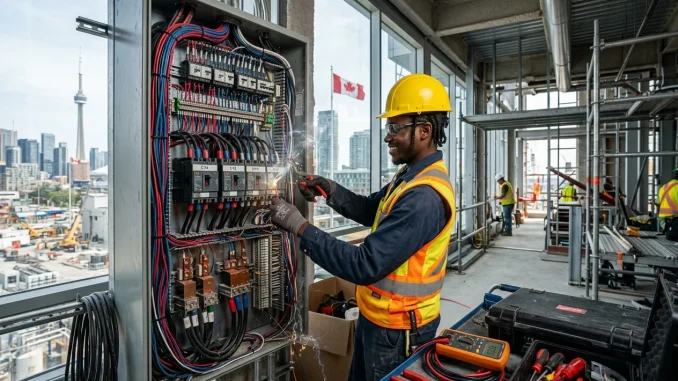
Canada Has a Shortage of Electricians — and It’s Your Opportunity
Here is a number that should get your attention: Canada needs to fill over 250,000 skilled trades positions by 2030, and electricians are at the very top of the shortage list. Across Alberta’s booming oil and gas sector, Ontario’s construction corridor, and British Columbia’s green energy projects, licensed electricians are in such critical demand that Canadian employers are turning to international recruitment to plug the gap — and they are doing it with full government backing.
Electrician jobs in Canada with visa sponsorship 2026 are real, government-approved, and actively being filled right now. We are talking about Labour Market Impact Assessment (LMIA)-backed positions paying between CAD $75,000 and $155,000 annually, depending on your experience level, trade specialisation, and province. For skilled electricians in Nigeria and across Africa, this is one of the most concrete, structured, and well-paying pathways to work abroad that exists in 2026.
This guide covers everything you need — the immigration reality, the salary breakdown, the right employers, the exact qualifications, and a step-by-step roadmap to move from application to landing in Canada. Read this in full. It was written for you.
Why Canada Is Hiring Electricians in 2026
A Perfect Storm of Demand
Canada’s electrician shortage is not a temporary blip — it is a structural crisis driven by three converging forces that show no sign of slowing down.
First, the retirement wave. A large proportion of Canada’s experienced licensed electricians are within five to ten years of retirement. There are simply not enough young Canadians entering apprenticeship programmes to replace them at the rate needed.
Second, the infrastructure explosion. The Canadian government has committed billions of dollars to roads, transit systems, LNG facilities, housing construction, and digital infrastructure. Every single one of those projects requires electricians at every stage.
Third, the green energy revolution. Canada’s push toward net-zero by 2050 means solar farms, wind turbines, EV charging networks, and smart-grid upgrades are being built coast to coast — all of which require certified electrical expertise.
What the Data Actually Says
According to BuildForce Canada, over 250,000 construction-related jobs need to be filled by 2030, with electricians rated as a top-priority shortage occupation. Construction electricians are classified under NOC 72200 (TEER 2) and industrial electricians under NOC 72201 (TEER 2) — both are listed by IRCC.com as fully eligible for Express Entry’s Federal Skilled Trades Program (FSTP), multiple Provincial Nominee Programs (PNPs), and the Temporary Foreign Worker Program (TFWP) via LMIA.
Government Immigration Support
The Canadian federal government has specifically expanded immigration pathways for TEER 2 and TEER 3 tradespeople, recognising the crisis as a national priority. Provinces like Alberta, British Columbia, Saskatchewan, and the Atlantic provinces all maintain active PNP streams for electricians, with Alberta and BC listed by GoFarGlobal as the top provinces for electrician immigration and employment in 2026.
Important 2026 update: Ontario’s Provincial Nominee Program (OINP) was repealed on May 30, 2026, as confirmed by IRCC.com. New replacement streams have not yet launched. If you are targeting Ontario, your best route is now the Federal Skilled Trades Program through Express Entry or an LMIA-backed work permit while you build Canadian work experience.
RELATED ARTICLES:
- Welder Jobs in Canada with Visa Sponsorship 2026 – Salary CAD $55,000 – $95,000 | How to Apply
- Chef Jobs in Canada with Visa Sponsorship 2026 – Salary CAD $65,000 – $125,000 | How to Apply
- Warehouse Operative Jobs in Canada with Visa Sponsorship 2026 – Salary CAD $45,000 – $85,000 | How to Apply
Visa Sponsorship: What It Means for You
The Simple Explanation
Visa sponsorship means a Canadian employer takes responsibility — legally and financially — for bringing you to Canada to work. For electricians, the standard pathway is through the LMIA (Labour Market Impact Assessment) process, administered by Employment and Social Development Canada (ESDC).
Here is exactly how it works:
- A Canadian employer needs a licensed or skilled electrician.
- They advertise locally and cannot fill the role with a Canadian citizen or permanent resident.
- They apply to ESDC for a positive LMIA — a document confirming that the shortage is real and that a foreign worker may legally be hired.
- Once the LMIA is approved, you receive a formal job offer letter and use it — along with the LMIA number — to apply for a Canadian Temporary Work Permit through Immigration, Refugees and Citizenship Canada (IRCC).
Who Qualifies for Visa Sponsorship?
- Electricians with verifiable trade qualifications — apprenticeship certificates, diplomas, or recognised trade credentials
- Those with 1–5+ years of hands-on experience in electrical installation, maintenance, or industrial systems
- Applicants who can demonstrate basic English communication competency
- Candidates willing and able to relocate to Canada
What Your Employer Covers
When an LMIA position is genuine, your sponsoring employer pays the CAD $1,000 LMIA application fee — not you. Many also provide:
- Work permit application support (documentation guidance)
- Relocation assistance — flights, initial accommodation, and settling-in allowance
- Trade skills assessment arranged by the employer
- Benefits from your first day of employment
Critical warning: A legitimate Canadian employer will NEVER ask you to pay for an LMIA, a job offer letter, or a visa approval. If anyone — agent, recruiter, or “employer” — demands an upfront payment for any of these, it is a scam. Walk away immediately.
Average Electrician Salary in Canada in 2026
The Real Numbers — No Estimates, No Guesswork
According to the comprehensive WorkZen Canadian Electrician Salary Guide 2026, electrician salaries in Canada break down as follows:
| Experience Level | Annual Salary (CAD) | Hourly Rate |
|---|---|---|
| Pre-Apprentice / Helper | $32,000 – $42,000 | $16 – $21/hr |
| Apprentice (Year 1–2) | $38,000 – $52,000 | $19 – $26/hr |
| Apprentice (Year 3–4) | $50,000 – $68,000 | $25 – $34/hr |
| Journeyman (Licensed) | $72,000 – $100,000 | $36 – $50/hr |
| Master Electrician | $90,000 – $130,000 | $45 – $65/hr |
| Industrial Specialist | $90,000 – $120,000+ | $45 – $60/hr |
| High-Voltage / Linework | $104,000 – $155,000+ | $50 – $75/hr |
Salary by Province
Alberta leads the country in electrician pay, driven by oil and gas demand:
| Province | Journeyman Annual |
|---|---|
| Alberta | $87,000 – $114,000 |
| Ontario | $83,000 – $108,000 |
| British Columbia | $79,000 – $104,000 |
| Saskatchewan | $79,000 – $100,000 |
| Manitoba | $73,000 – $94,000 |
| Nova Scotia | $67,000 – $87,000 |
| Territories | $94,000 – $125,000+ |
Source: WorkZen 2026 Salary Guide
Salary Boosters
- Overtime: A journeyman working 10 hours of weekly OT at 1.5x can add CAD $35,000+ annually
- Union membership (IBEW): Union electricians earn 15–25% more in total compensation than non-union
- Red Seal certification: Commands respect and consistently higher rates
- Industrial or high-voltage specialisation: Adds $10–$20/hr to your base rate
Benefits Typically Included
- Extended health, dental, and vision insurance
- RRSP (Registered Retirement Savings Plan) employer contributions
- Life insurance and disability coverage
- Paid vacation (2–4 weeks)
- Overtime pay at 1.5x hourly rate
- Company vehicle (for some roles)
- Relocation package for international hires
Top Employers Currently Sponsoring Electricians in Canada
Who Is Actively Hiring International Electricians?
These are established Canadian employers with a track record of LMIA-backed international recruitment for electricians:
1. PCL Construction — Edmonton, Alberta
One of Canada’s largest and most respected general contracting companies. PCL works on massive industrial, commercial, and infrastructure projects across every province. They hire construction and industrial electricians through LMIA sponsorship for both project-based and permanent roles. [Apply at PCL Construction]
2. Aecon Group Inc. — Toronto, Ontario
A publicly traded infrastructure giant working on power plants, transit systems, pipelines, and civil projects nationwide. Aecon has a long history of international recruitment and offers structured onboarding for foreign-trained tradespeople, including electricians. [Apply at Aecon Group]
3. Ledcor Group — Vancouver, British Columbia
One of Canada’s most diversified construction companies, active in industrial, building, and infrastructure sectors across the country. Ledcor regularly hires journeyman electricians for large-scale projects and provides LMIA support for qualified international applicants. [Apply at Ledcor Group]
4. EllisDon Corporation — Mississauga, Ontario
A major construction and building services company with projects spanning data centres, hospitals, industrial facilities, and commercial developments. EllisDon actively recruits experienced electricians and has sponsored international workers previously. [Apply at EllisDon Corporation]
5. Suncor Energy — Calgary, Alberta
Canada’s largest integrated energy company. Suncor operates oil sands facilities, upgraders, and refineries across Alberta, all of which require large numbers of industrial and maintenance electricians. They are among the top LMIA-sponsoring employers in the country for trades. [Apply at Suncor Energy]
6. Hydro One / BC Hydro / Manitoba Hydro — Multiple Provinces
Canada’s major provincial utility companies regularly hire construction and high-voltage electricians, powerline technicians, and substation technicians. Hydro One in Ontario, BC Hydro in British Columbia, and Manitoba Hydro all maintain international recruitment programmes for qualified tradespeople. [Apply at Hydro One] [Apply at BC Hydro]
7. NextGen Electrical Services Ltd. — Kamloops, British Columbia
As seen on Indeed Canada, NextGen actively recruits journeyman electricians for commercial and construction projects in BC, offering wages of $40–$45/hour, with full benefits including RRSP match, dental, life insurance, and a company vehicle. [Apply at NextGen Electrical Services]
Requirements & Qualifications
What You Genuinely Need to Be Competitive
Canadian employers and IRCC are very thorough. Meeting minimum requirements is your floor — exceeding them is what wins you the offer.
Minimum Education
- Secondary school graduation (WAEC/NECO equivalent accepted for most roles)
- Completion of a 4–5 year electrical apprenticeship programme OR its equivalent in trade school education and work experience
- A Diploma or Certificate in Electrical Installation from a recognised technical institution significantly boosts your profile
Work Experience
- Minimum 1–2 years for sponsored helper or apprentice roles
- Minimum 2 years verified journeyman-level experience for FSTP Express Entry
- For Senior/Industrial roles: 3–5+ years with specific system experience (motor controls, PLCs, high-voltage, renewable energy)
- All experience must be verifiable: employer reference letters on company letterhead, employment contracts, pay stubs, or tax records
Certification — The Most Critical Factor
This is what separates an approved application from a rejected one:
- Trade Certification — Required by law in most provinces. According to Canada’s Job Bank, trade certification for construction electricians is compulsory in: Newfoundland & Labrador, Nova Scotia, PEI, New Brunswick, Quebec, Ontario, Manitoba, Saskatchewan, and Alberta. It is voluntary but strongly recommended in BC, Yukon, NWT, and Nunavut.
- Red Seal Endorsement — The interprovincial gold standard. As confirmed by Red Seal Canada, the Red Seal is designated for construction electricians across all 13 provinces and territories. It allows you to work anywhere in Canada without re-certifying and commands respect from every employer. Passing the Red Seal exam after arriving in Canada (or before, if your credentials are assessed) is your strongest career move.
- Foreign Credential Recognition — If your qualifications were earned outside Canada, get an Educational Credential Assessment (ECA) through a body like World Education Services (WES) before applying. Some provinces also allow you to challenge the provincial trade certification exam directly based on foreign credentials.
Language Requirements
- LMIA Work Permit (TFWP): No formal IELTS requirement, but basic functional English is expected by employers and border officers
- Express Entry (Federal Skilled Trades Program): Minimum CLB 5 in speaking and listening, CLB 4 in reading and writing — roughly IELTS General 5.0 speaking/listening, 3.5–4.0 reading/writing
- Stronger English scores (CLB 7–9) add 30–90 CRS points to your Express Entry profile, making a significant difference
Professional Registration
There is no single national registration body for electricians in Canada, but each province has its own regulatory authority. Key bodies include:
- Alberta: Alberta Advanced Education, Apprenticeship and Industry Training (AIT)
- Ontario: Skilled Trades Ontario
- British Columbia: Skilled Trades BC
- Saskatchewan: Saskatchewan Apprenticeship and Trade Certification Commission
Contact the regulatory authority in your target province well in advance to understand their foreign credential recognition process.
Step-by-Step: How to Apply for Electrician Jobs in Canada with Visa Sponsorship
Your Complete Roadmap from Nigeria to Canada
Step 1: Gather and Organise All Your Documents
Before you apply for a single job, assemble your complete document portfolio. This includes: international passport, electrical trade certificates, apprenticeship completion documents, employer reference letters (on company letterhead, signed, with contact details), educational certificates (secondary and technical), any safety certifications (first aid, WHMIS, etc.), and two passport photographs. Scan and back up everything digitally. Immigration applications have zero tolerance for missing documents.
Step 2: Get Your CV into Canadian Format
Your Nigerian CV format will not be read in Canada. Convert it to a Canadian resume — 1–2 pages maximum, reverse chronological order, no photo, no date of birth, no marital status. Lead with a strong professional summary, then your certifications, then your work experience with bullet points listing specific systems and tasks. Quantify your experience wherever possible: “Installed and commissioned 3-phase distribution systems for 12 industrial facilities over 4 years.” Download the Government of Canada’s Job Bank resume template to get the format right.
Step 3: Search for LMIA-Approved Electrician Jobs
Use targeted search terms on the platforms listed in the job boards section below:
- “Electrician LMIA Canada 2026”
- “Journeyman electrician visa sponsorship Canada”
- “NOC 72200 job offer Canada”
- “Industrial electrician LMIA Alberta”
Filter by “full-time,” your target province, and salary minimum. Prioritise roles that explicitly mention LMIA or visa sponsorship in the listing.
Step 4: Apply and Tailor Every Application
Send your application to a minimum of 15–20 positions. Do not send identical cover letters. Each letter should name the company, state the specific systems you have experience with, mention your qualifications clearly, and explicitly state that you are an international applicant seeking LMIA-backed employment. Ambiguity about your status wastes everyone’s time.
Step 5: Pass Your Interview
Canadian employers conduct initial interviews by video call — Zoom, Google Meet, or Microsoft Teams. Be punctual. Dress professionally. Have your documents visible on your desk. You may be asked technical questions (how to read a single-line diagram, how to troubleshoot a motor starter, Canadian Electrical Code basics) or asked to complete a practical trade test. Prepare. A failed trade test ends your application immediately.
Step 6: Receive Your Job Offer and LMIA Approval
Once selected, your employer issues a formal job offer letter and submits the LMIA application to ESDC. LMIA processing typically takes 2–4 months for high-wage positions (which most licensed electrician roles qualify as). During this time, do not pay any fees, do not send money to anyone, and do not resign from any current employment until you have official documentation in hand.
Step 7: Apply for Your Canadian Work Permit
Once the LMIA is approved, you submit your work permit application online through the official IRCC portal at canada.ca/immigration. Your application package must include:
- Completed work permit application (IMM 1295)
- Valid international passport (minimum 6 months validity beyond intended stay)
- Formal job offer letter with LMIA approval number
- Educational credentials and trade certificates
- Medical examination report from an IRCC-approved panel physician in Nigeria (Lagos or Abuja)
- Police clearance certificate from the Nigeria Police Force
- Two passport photographs
- Proof of funds (if required)
- Biometrics (booked at the Canadian Visa Application Centre in Lagos or Abuja)
Current work permit processing times from Nigeria average 6–16 weeks from submission. Plan accordingly.
Step 8: Travel and Begin Work
On arrival at a Canadian port of entry, a Canada Border Services Agency (CBSA) officer issues your physical work permit document. Confirm all details are correct on the spot — name spelling, expiry date, employer name, and location. Report to your employer as agreed, and begin building your Canadian career.
Best Job Boards to Find Sponsored Electrician Jobs in Canada
Where to Focus Your Search Energy
1. Job Bank Canada (jobbank.gc.ca)
The official Government of Canada employment portal. All LMIA-approved positions must be posted here by law. Search “electrician” + your target province, and filter for listings noting “foreign workers welcome” or “work permit.” This is your most trusted source — every listing is tied to a real Canadian employer.
2. Indeed Canada (ca.indeed.com)
Canada’s most-used job board. Indeed currently lists over 2,000 LMIA and visa sponsorship-linked electrician positions, with roles paying $52,000–$110,000+. Set up job alerts using “LMIA electrician” and “visa sponsorship electrician Canada” and check daily.
3. LinkedIn Jobs (linkedin.com/jobs)
Invaluable for both applications and networking. Optimise your LinkedIn profile with your certifications, NOC codes, and a professional headline. Connect with Canadian electrical contractors, union recruiters (IBEW locals), and immigration-linked HR professionals. Set a job alert for “journeyman electrician Canada” and “LMIA electrician.”
4. ZipRecruiter Canada (ziprecruiter.com)
ZipRecruiter currently lists over 1,000 LMIA and visa sponsorship electrician roles across Canada, with hourly rates from $19–$47/hr and annual salaries clearly stated. The platform’s one-click apply feature and salary transparency make it highly efficient for international applicants.
5. Workopolis (workopolis.com)
A Canada-specific job board with a strong database of electrical and trades positions. Used heavily by Canadian contractors and construction companies. Search “electrician” combined with “sponsorship” or “LMIA” and filter by province.
Common Mistakes to Avoid
These are the errors that cost qualified electricians their shot at Canada. Read them carefully:
- Paying anyone for an LMIA or job offer letter. This cannot be stated enough. The LMIA fee is paid by the employer to ESDC — it is not your cost. Any individual, agency, or “recruiter” that asks you to pay for an LMIA document, a job offer letter, a visa approval, or a Canadian employer contact is running a scam. Never pay upfront fees for immigration documents.
- Submitting a Nigerian CV format. A five-page CV with a passport photo, date of birth, and religion will be discarded without being read. Use the Canadian resume format — 1–2 pages, results-focused, no personal data. This single mistake eliminates more Nigerian applicants than any qualification gap.
- Applying without understanding provincial certification requirements. The rules are different in every province. In Ontario and Alberta, you cannot legally work as an electrician without provincial trade certification. In BC, it is voluntary but practically essential for employment. Research your target province’s requirements before accepting any job offer — you do not want to arrive in Canada and discover you cannot legally work until you pass an exam.
- Ignoring the Red Seal process. Many international electricians underestimate how much the Red Seal matters. Even if your home country certification is excellent, Canadian employers want to see a pathway to Red Seal. Begin the foreign credential recognition process early — contact the provincial trade authority in your target province as soon as you know where you want to work.
- Targeting Ontario without understanding the 2026 PNP change. Ontario’s entire Provincial Nominee Program (OINP) was suspended as of May 30, 2026, per IRCC.com. If you were counting on Ontario’s Skilled Trades stream for your permanent residency pathway, you need a new plan. Redirect to Federal Skilled Trades Express Entry, LMIA work permit, or Alberta/BC/Saskatchewan PNP streams instead.
Frequently Asked Questions (FAQ)
Is IELTS required to apply for electrician jobs in Canada with visa sponsorship?
For LMIA-backed work permits under the Temporary Foreign Worker Program (TFWP), a formal IELTS result is generally not mandatory — but basic English proficiency is expected by employers and border officers. For Express Entry’s Federal Skilled Trades Program (FSTP), a recognised language test is mandatory, with minimums of CLB 5 in speaking and listening, CLB 4 in reading and writing. This approximately equals IELTS General Training scores of 5.0 in speaking/listening and 3.5–4.0 in reading/writing.
Can I bring my family to Canada once I have an electrician work permit?
Yes — if your work permit is for 6 months or longer, your spouse or common-law partner is generally eligible for an Open Work Permit, and your dependent children are eligible to attend Canadian schools. Apply for family permits simultaneously where possible to minimise separation time. Confirm eligibility with a licensed Regulated Canadian Immigration Consultant (RCIC) after your work permit is issued.
Can electrician jobs in Canada lead to permanent residency (PR)?
Absolutely. Electricians under NOC 72200 and 72201 are fully eligible for permanent residency through multiple routes: Express Entry Federal Skilled Trades Program (with a job offer or Canadian provincial certificate), Provincial Nominee Programs in Alberta, BC, Saskatchewan, and Atlantic provinces, and the Canadian Experience Class (CEC) after accumulating one year of Canadian work experience. Most electricians who enter Canada on a work permit achieve PR within 2–3 years of arrival.
What is the difference between a construction electrician and an industrial electrician in Canada?
Construction electricians (NOC 72200) install, maintain, and repair electrical systems in residential, commercial, institutional, and industrial buildings — wiring, panels, lighting, conduit systems. Industrial electricians (NOC 72201) specialise in electrical equipment in industrial and manufacturing facilities — motor control centres, programmable logic controllers (PLCs), high-voltage systems, and factory automation. Industrial electricians are paid more ($90,000–$120,000+) but require more specialised training and experience.
How long does the full LMIA and work permit process take for Nigerian applicants?
The realistic timeline from job offer to arrival in Canada is 5–10 months. This breaks down as: LMIA application processing by ESDC — 2–4 months; work permit application processing by IRCC — currently 6–16 weeks for Nigerian applicants. Starting your job search and documentation preparation now puts you in a position to be in Canada by mid-to-late 2026 if the process moves efficiently.
Conclusion: Canada Is Ready for You — Now It Is Your Turn to Act
Canada is not quietly hoping skilled electricians will apply. It is actively building immigration pathways, approving LMIAs, inviting provinces to nominate tradespeople, and paying salaries that represent genuine financial transformation for anyone who makes the move. The country faces a structural shortage it cannot solve from within its own borders — and your skills are exactly what is needed.
Electrician jobs in Canada with visa sponsorship 2026 offer you a salary between CAD $75,000 and $155,000, a structured pathway to permanent residency, and a chance to build a stable future for yourself and your family in one of the world’s most liveable countries. The route is clear: get your credentials in order, build your Canadian resume, apply through verified job boards, and trust the LMIA process.
Do not wait for a perfect moment — the demand is now, the pathways are open, and the employers are ready. Take the first step today.
Bookmark this page and share with someone looking for opportunities abroad.
Leave a Reply