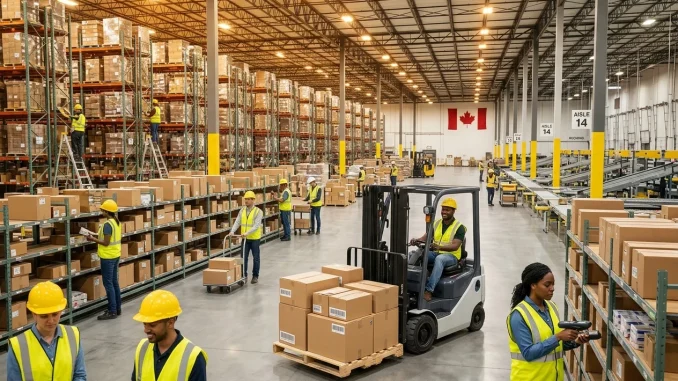
Canada’s national Job Bank currently lists 481 active warehouse operative (NOC 75101) job postings across the country — and that number refreshes every single day as employers across Ontario, British Columbia, Alberta, Quebec, and Atlantic Canada compete for workers they simply cannot find domestically. If you are a Nigerian or African professional looking for a clear, structured, and legally supported pathway to work and live in Canada, warehouse operative jobs in Canada with visa sponsorship 2026 may be one of the most accessible, fastest-moving opportunities available to you right now.
The reason is structural, not seasonal. Canada’s e-commerce revolution, supply chain expansion, and ageing workforce have combined to create a persistent labour gap that domestic hiring alone cannot fill. Employers are turning to the Temporary Foreign Worker Program (TFWP), the Atlantic Immigration Program (AIP), and Provincial Nominee Programs (PNPs) to legally recruit warehouse operatives from abroad — funding the LMIA process, providing relocation support, and opening pathways to Canadian permanent residence for workers who commit.
According to the Canada Job Bank wage report for NOC 75101, updated November 2025, warehouse operatives nationally earn between CAD $16.55 and CAD $30.29 per hour, with specialised roles — forklift operators, inventory coordinators, and warehouse supervisors — reaching CAD $35.00 to $40.00 per hour. Annualised across full-time hours, with overtime, shift differentials, and bonuses, experienced warehouse professionals in Canada’s top-paying provinces earn CAD $45,000 to $85,000 per year — a figure that represents life-changing earning power for workers relocating from Nigeria or elsewhere in Africa.
This guide gives you every verified data point, employer name, immigration pathway, and practical step you need to secure your position in Canada’s booming warehouse sector in 2026.
warehouse-operative-jobs-in-canada: Why Canada Is Hiring Warehouse Operatives in 2026
The Labour Shortage Is Structural — Not Temporary
Canada’s warehousing and logistics sector is facing a worker shortage that economists classify as structural — driven by demographic shifts and industry expansion that outpaces domestic labour supply — rather than a temporary gap caused by economic conditions. This distinction matters enormously for international applicants, because it means Canadian employers cannot simply wait for a downturn to reduce their hiring pressure. They need workers now, and they need them continuously.
The primary causes of this structural shortage are well-documented:
- E-commerce growth at unprecedented scale — Amazon, Walmart, Costco, and thousands of smaller Canadian e-commerce businesses have expanded their distribution networks dramatically since 2020. Every new fulfilment centre that opens requires hundreds of warehouse operatives to staff it around the clock, seven days a week
- An ageing domestic workforce — Canada’s working-age population is among the oldest in the G7. The warehousing and logistics sector has one of the highest concentrations of workers over 50, meaning retirements are outpacing new entrants from the domestic labour market every year
- Post-pandemic supply chain reinvestment — Canadian companies that previously relied on lean, just-in-time supply chains have invested heavily in domestic warehouse capacity since 2021, creating thousands of new permanent positions in logistics hubs across every province
- Cross-border trade expansion — The Canada-United States-Mexico Agreement (CUSMA) has increased the volume of goods moving through Canadian distribution centres, particularly in Ontario, Alberta, and British Columbia
Government Immigration Policy Is Actively Supporting International Warehouse Recruitment
The Canadian government has not left employers to figure this out alone. Multiple immigration frameworks have been specifically adapted or expanded to support the recruitment of warehouse operatives from abroad:
- NOC 75101 (Material Handlers / Warehouse Operatives) is TEER 4 — the classification that covers the widest range of physical labour and logistics roles in Canada’s National Occupational Classification system. TEER 4 classifications are eligible for LMIA-backed TFWP work permits, PNP streams in multiple provinces, and — after 12 months of Canadian work experience — the Canadian Experience Class (CEC) under Express Entry
- The Atlantic Immigration Program (AIP) — covering Nova Scotia, New Brunswick, Prince Edward Island, and Newfoundland — provides an LMIA-exempt sponsorship route for warehouse operatives at designated employers in Atlantic Canada, significantly reducing the timeline from job offer to work permit
- The Rural and Northern Immigration Pilot (RNIP) — covering smaller communities in Ontario, Manitoba, Saskatchewan, Alberta, and BC — specifically targets warehouse and logistics workers for communities with established distribution centres that cannot compete with urban employers for domestic talent
- 81.6% of NOC 75101 workers in Canada receive at least one non-wage employer benefit — confirming these are overwhelmingly full-time, permanent-type positions with real employment protections, per Canada’s Job Bank
RELATED ARTICLE:
- Truck Driver Jobs in Canada with Visa Sponsorship 2026 – Salary CAD $85,000 – $150,000 | How to Apply
- Care Worker Jobs in Canada with Visa Sponsorship 2026 – Salary CAD $45,000 – $85,000 | How to Apply
Visa Sponsorship: What It Means for You
The Plain-English Explanation
Visa sponsorship for warehouse operative jobs in Canada means a Canadian employer with a genuine labour shortage provides you with a formal job offer and supports your legal right to work in Canada — most commonly through a Labour Market Impact Assessment (LMIA) under the Temporary Foreign Worker Program (TFWP).
In practical terms, the process works like this: your prospective employer applies to Employment and Social Development Canada (ESDC) to prove they tried to hire a Canadian worker first and could not find one who was available and qualified. When ESDC is satisfied, they issue a positive LMIA — a document confirming that hiring you, a foreign worker, will not negatively affect the Canadian labour market. You use that LMIA reference number to apply to Immigration, Refugees and Citizenship Canada (IRCC) for a closed work permit that authorises you to work specifically for that employer in that role in that province.
The employer pays the LMIA application fee — CAD $1,000 per position. It is a federal offence under the Immigration and Refugee Protection Act for any employer or recruiter to charge this cost back to the worker. Any agent, recruiter, or individual in Nigeria, Ghana, or elsewhere in Africa who claims you must pay CAD $5,000, USD $10,000, or any significant upfront sum for a “confirmed LMIA” or “guaranteed Canadian warehouse job” is committing immigration fraud.
Who Qualifies for LMIA-Backed Visa Sponsorship?
Warehouse operative positions under NOC 75101 fall under the low-wage LMIA stream of the TFWP — because the national median wage of $22.00/hr for this occupation falls below the provincial median wage threshold in most provinces. This has important practical implications:
- Low-wage LMIA stream caps: ESDC limits the proportion of low-wage TFWP workers any employer can have on payroll at any given time (typically 10–20% of the total workforce at a worksite). This cap means employers must be selective about which roles they sponsor internationally — they prioritise the hardest-to-fill positions
- Cap exemptions: The low-wage stream cap is waived entirely for employers in the food processing, fish processing, and primary agriculture sectors — a fact relevant to Nigerian applicants targeting cold storage, food distribution, and agricultural processing warehouses
- Atlantic Immigration Program: For warehouse operatives targeting Atlantic Canada, the AIP is LMIA-exempt and has no low-wage cap — making it significantly easier for designated Atlantic employers to sponsor you compared to the TFWP low-wage stream
What the Employer Covers Under Sponsorship
Under a legitimate LMIA-backed sponsorship arrangement, the employer is legally required or commonly expected to cover:
- LMIA application fee: CAD $1,000 per position, paid to ESDC — not recoverable from the worker under any circumstances
- Job Bank advertising: All mandatory recruitment advertising costs before LMIA submission
- Transportation to Canada: For low-wage LMIA positions, employers are legally required to pay for your round-trip transportation (from Nigeria to Canada and return at end of contract)
- Suitable accommodation or accommodation support: Employers must ensure you have access to affordable housing upon arrival — many provide temporary company housing or contribute a housing allowance in your first 30 to 60 days
- WHMIS training: Most warehouse employers in Canada provide Workplace Hazardous Materials Information System (WHMIS) training and forklift certification upon arrival — at zero cost to you
You are responsible for your work permit application fee (~CAD $155), biometrics (~CAD $85), immigration medical exam (~USD $150–$300 at a Panel Physician in Lagos or Abuja), and any English language test fees (~USD $200–$250 for IELTS).
Average Warehouse Operative Salary in Canada in 2026
Official Wage Data: Canada’s Job Bank (NOC 75101)
The following wage data is sourced directly from Canada’s Job Bank, updated November 19, 2025 — the most current government-verified dataset available:
| Province / Territory | Low ($/hr) | Median ($/hr) | High ($/hr) | Annual (Median) |
|---|---|---|---|---|
| Canada (National) | $16.55 | $22.00 | $30.29 | ~CAD $45,760 |
| British Columbia | $18.25 | $22.00 | $33.99 | ~CAD $45,760 |
| Alberta | $16.50 | $22.00 | $31.95 | ~CAD $45,760 |
| Quebec | $16.94 | $22.00 | $31.32 | ~CAD $45,760 |
| Ontario | $17.60 | $21.50 | $29.96 | ~CAD $44,720 |
| Manitoba | $16.00 | $21.12 | $29.69 | ~CAD $43,930 |
| Saskatchewan | $15.35 | $20.00 | $30.00 | ~CAD $41,600 |
| Yukon Territory | $18.51 | $23.66 | $31.92 | ~CAD $49,213 |
Source: Canada Job Bank NOC 75101, November 2025. Annual figures calculated at 2,080 hrs/year.
Role-by-Role Salary Breakdown (2026)
| Role & Experience Level | Hourly Rate (CAD) | Annual Salary (CAD) |
|---|---|---|
| Entry-level warehouse associate (0–1 yr) | $16.55 – $20.00 | $34,424 – $41,600 |
| General picker/packer, mid-level (1–3 yrs) | $20.00 – $23.00 | $41,600 – $47,840 |
| Forklift operator (certified) | $22.00 – $28.00 | $45,760 – $58,240 |
| Inventory clerk / shipper-receiver (3–5 yrs) | $21.00 – $29.00 | $43,680 – $60,320 |
| Cold storage / hazmat-handling specialist | $24.00 – $32.00 | $49,920 – $66,560 |
| Warehouse supervisor / team lead (5+ yrs) | $28.00 – $40.00 | $58,240 – $83,200 |
Sources: Canada Job Bank, seasonalworkvisa.com, harisbeds.com high-paying factory/warehouse guide
The CAD $45,000 to $85,000 salary range cited in this article is therefore fully achievable — beginning at the entry-mid level and rising through forklift certification, specialisation in cold storage or hazardous materials, overtime hours, and progression to supervisory roles.
Benefits Package Confirmed for NOC 75101 Workers
Per Canada’s Job Bank, 81.6% of NOC 75101 workers receive at least one non-wage benefit from their employer. Standard benefits at major warehouse employers include:
- Overtime pay: 1.5× regular rate above provincial thresholds (Ontario: 44 hrs/week; BC: 40 hrs/week; Alberta: 44 hrs/week). Long-haul warehouse operatives averaging 48–52 hours weekly can add CAD $4,000–$10,000 in annual overtime
- Night shift and evening differentials: CAD $1.00–$3.00 per hour additional for shifts between 4:00pm and 8:00am — consistent across most major employers
- Health and dental insurance: Group extended health coverage (prescription medications, dental, vision) from day 30 or 90 of employment
- RRSP matching: Employer contributions of 3%–5% of annual salary to the Registered Retirement Savings Plan
- Employee discounts: Confirmed at Loblaw, Walmart, Costco, and Canadian Tire distribution centres — 10%–30% on retail products
- Paid vacation: Minimum 2 weeks annually from year one, rising to 3 weeks after 5 years (per Canada Labour Code)
- Performance and safety bonuses: CAD $500–$3,000 annually at major distribution centres for accident-free records and productivity targets
- Relocation allowance: CAD $1,000–$3,000 at select Atlantic, Saskatchewan, and rural Ontario employers for internationally recruited workers under LMIA or AIP
Top Employers Currently Sponsoring Warehouse Operatives in Canada
The following employers are confirmed as active or LMIA-capable warehouse operative recruiters, with documented international hiring histories, established career portals, and — in several cases — AIP or PNP designation that enables faster sponsorship pathways.
1. Amazon Canada
Amazon Canada operates one of the largest warehouse and distribution networks in the country, with fulfilment centres, sortation centres, and delivery stations located across the Greater Toronto Area (Mississauga, Brampton, Scarborough), the Greater Vancouver Area (Delta, Surrey, Richmond), Calgary, Edmonton, Ottawa, and Montreal. Amazon is consistently listed among the most active warehouse employers in Canada, per harisbeds.com’s factory and warehouse visa sponsorship guide and afzani.com’s warehouse jobs guide.
Amazon’s warehouse roles include Fulfilment Associate, Sortation Associate, Delivery Station Associate, Robotics Technician, and Area Manager (Supervisory) — with pay ranging from $20.00/hr for entry-level associates to $30.00+/hr for technical and lead roles. Amazon Canada operates 24/7 across three shifts, creating consistent hiring demand that is never truly seasonal. Its LMIA processes — conducted through Service Canada’s national employer portal — have been used to sponsor international warehouse workers for Canadian positions.
[Apply at Amazon Canada]
2. Walmart Canada Distribution Centres
Walmart Canada operates a national network of regional distribution centres and e-commerce fulfilment centres to supply its 400+ retail stores. Key distribution hubs are located in Cornwall (Ontario), Belleville (Ontario), Calgary (Alberta), and Surrey (British Columbia). Walmart Canada is explicitly named as an LMIA-capable warehouse employer by seasonalworkvisa.com, visajobsavenue.com, and pngfb.com’s LMIA warehouse guide.
Walmart Canada’s distribution centre roles include Warehouse Associate, Freight Flow Operative, Forklift Operator, Quality Control Associate, and Distribution Supervisor — at wages ranging from $20.00/hr to $32.00/hr depending on seniority. Walmart’s structured HR department, large workforce size, and established relationships with Service Canada make it one of the most administratively capable LMIA sponsors in the Canadian retail logistics space.
[Apply at Walmart Canada]
3. Loblaw Companies Limited
Loblaw Companies is Canada’s largest food and pharmacy retailer, operating distribution centres and fresh food warehouses to support its network of Loblaws, Shoppers Drug Mart, No Frills, Real Canadian Superstore, and Zehrs locations. Loblaw’s supply chain infrastructure spans the country — from massive automated distribution centres in Brampton and Laval to regional fresh food hubs in Halifax, Regina, and Kamloops.
Loblaw is specifically named as an LMIA-capable international warehouse employer by both harisbeds.com and afzani.com. Warehouse roles at Loblaw include Order Picker, Produce Handler, Ambient Warehouse Operative, Refrigerated Goods Handler, Forklift Operator, and Warehouse Shift Supervisor — with wages from $20.00/hr to $35.00/hr. Loblaw’s consistent peak-season hiring (Easter, back-to-school, Christmas) creates LMIA-eligible surges that international applicants can target strategically.
[Apply at Loblaw Companies]
4. FedEx Canada
FedEx Canada operates a national network of package handling facilities, freight hubs, and sortation centres — including major facilities in Toronto Pearson area, Vancouver, Calgary, Edmonton, Montreal, and Halifax. FedEx is named as a confirmed international warehouse hiring employer by inedjobs.com and afzani.com.
FedEx Canada’s warehouse roles include Package Handler, Material Handler, Freight Handler, Hub Operations Associate, and Warehouse Operations Supervisor. The physical intensity of FedEx positions — unloading and sorting packages continuously, operating scanning systems, managing cross-dock freight — means FedEx actively recruits for physical stamina and reliability over prior formal logistics credentials. For Nigerian applicants with strong physical work backgrounds and basic English, FedEx is one of the most accessible entry points into the Canadian warehouse sector.
[Apply at FedEx Canada]
5. DHL Supply Chain Canada
DHL Supply Chain Canada is one of the world’s largest third-party logistics (3PL) providers, operating a network of contract logistics warehouses across Ontario, Quebec, British Columbia, and Alberta on behalf of retail, pharmaceutical, automotive, and consumer goods clients. Unlike Amazon or Walmart, which own their own distribution networks, DHL manages warehouses for other companies — meaning its hiring needs are broad, continuous, and diverse across multiple cargo types.
DHL Canada is named as an active LMIA-eligible international warehouse employer by harisbeds.com and seasonalworkvisa.com. DHL roles include Warehouse Operative, Material Handler, Inventory Coordinator, Forklift Operator, and Operations Supervisor. DHL’s 3PL model means the employer retains the HR and LMIA processing function while deploying workers across different client sites — giving internationally recruited operatives exposure to a variety of cargo environments, which builds career-advancing Canadian experience quickly.
[Apply at DHL Supply Chain Canada]
6. Costco Wholesale Canada
Costco Wholesale Canada operates both retail warehouse stores (which are themselves massive picking and distribution environments) and dedicated distribution depots in British Columbia, Alberta, Ontario, and Quebec. Costco is consistently ranked among Canada’s best employers for warehouse and logistics workers — offering wages that typically run 15–20% above sector median.
Costco is listed as an LMIA-capable international warehouse employer by pngfb.com and seasonalworkvisa.com. Warehouse roles include Warehouse Assistant, Night Shift Stocking Associate, Forklift Operator, and Department Supervisor. Costco’s workforce culture emphasises physical efficiency, team discipline, and consistent attendance — attributes that Nigerian applicants with backgrounds in structured manufacturing, freight, or logistics environments naturally possess and should highlight in their applications.
[Apply at Costco Wholesale Canada]
7. Metro Inc. Distribution Centres
Metro Inc. is one of Canada’s three largest food retailers — alongside Loblaw and Sobeys — operating supermarkets, discount stores, and pharmacy chains across Ontario and Quebec. Metro’s distribution centres in Montreal, Terrebonne, and Ottawa supply thousands of retail locations and require continuous staffing for receiving, ambient storage, refrigerated goods handling, order picking, and shipping operations.
Metro Inc. is identified as an LMIA-eligible international warehouse employer by visajobsavenue.com. Metro’s focus on food retail logistics — including fresh produce, frozen foods, and pharmaceutical distribution — creates roles with a broad range of physical demands and specialisations. Refrigerated goods handlers and cold-chain warehouse operatives at Metro earn premium wages (CAD $24.00–$32.00/hr) reflecting the additional training and physical conditions involved in cold storage work.
[Apply at Metro Inc.]
Requirements and Qualifications
Education Requirements
The minimum education requirement for NOC 75101 (Material Handlers / Warehouse Operatives) is, per the Canada Job Bank NOC 75101 profile, short-term on-the-job training with no formal education requirement — making this one of the most accessible skilled immigration categories in Canada’s entire NOC system.
In practical terms for most employers and LMIA applications:
- Secondary school certificate (WAEC/NECO Senior Secondary School Certificate in Nigeria) is the standard minimum stated on job postings and LMIA documentation
- No university degree is required under any PNP stream or TFWP category for NOC 75101 warehouse operative positions
- No professional registration body (unlike nursing’s NMC or teaching’s provincial licensing bodies) exists for warehouse operatives in Canada — there is no mandatory skills assessment or credential recognition process before your first day of work
- Educational Credential Assessment (ECA) is only required if you are applying for permanent residence through Express Entry and wish to claim educational points — it is not required for the LMIA work permit itself
Work Experience Requirements
- Entry-level (0–1 year experience): Accepted by most LMIA-sponsoring employers for general picker, packer, and material handler roles, with on-the-job training provided on arrival
- Mid-level (1–3 years): Required for forklift operator, shipper/receiver, and inventory clerk positions. Verifiable experience in a warehouse, logistics, production facility, or freight-handling environment in Nigeria or Africa is directly accepted by most Canadian employers
- Senior-level (3–5+ years): Required for warehouse supervisor, team lead, and senior inventory roles. Prior supervisory or team coordination experience in a physical work environment significantly increases your LMIA sponsorship priority, as these roles are harder to fill domestically
Include the following in your supporting documentation:
- Reference letters from previous employers on official company letterhead, specifying your role title, dates of employment, duties performed, and supervisor contact details
- Proof of certifications: Any forklift operation, heavy equipment, health and safety, or logistics certifications obtained in Nigeria — including FRSC vehicle endorsements for heavy goods handling if applicable
- Payslips or bank statements showing salary deposits from warehouse/logistics employers, as additional employment verification documentation
Language Requirements
- LMIA work permit (TFWP): No IRCC-mandated language test score is required for the work permit itself. However, functional English is assessed informally by the employer during the interview process. You must be able to read warehouse labels, understand dispatch instructions, follow safety signage, and communicate basic status updates to supervisors and team members
- Atlantic Immigration Program (AIP): Minimum CLB 4 in English (equivalent to approximately IELTS 4.0–4.5 overall)
- Saskatchewan SINP (Existing Work Permit Stream): Minimum CLB 4 in English
- Ontario OINP (Employer Job Offer stream): Minimum CLB 4 in English for NOC TEER 4 positions
- Canadian Experience Class (CEC) — post-arrival PR: Minimum CLB 5 in English (equivalent to approximately IELTS 5.0 overall)
- Test options: IELTS General Training (available at British Council and IDP centres in Lagos, Abuja, Port Harcourt, Benin City, and Ibadan) or CELPIP (available online). CLB 4 is a very achievable target for Nigerian applicants who completed secondary school in English-medium institutions
Physical and Operational Requirements
- Physical fitness: Warehouse work requires the ability to lift and carry items up to 50 lbs (approximately 23 kg) regularly, stand or walk for 8–12 hour shifts, operate pallet jacks, hand trolleys, and — with certification — counterbalance and reach forklifts
- Shift flexibility: Canada’s 24/7 distribution centres operate across three shifts (typically 6am–2pm, 2pm–10pm, 10pm–6am). Willingness to work rotating shifts — and the night/evening shift differentials that come with them (CAD $1–$3/hr extra) — significantly increases your employability and annual earnings
- WHMIS knowledge (Workplace Hazardous Materials Information System): Basic familiarity with WHMIS regulations is valued at all Canadian warehouse employers. Employers provide WHMIS training upon arrival; however, completing a free online WHMIS orientation before your interview demonstrates initiative and seriousness
- Forklift certification: A counterebalance forklift licence from Nigeria or elsewhere in Africa may be partially recognised by Canadian employers — particularly for assessment of existing knowledge — but Canadian provincial forklift certification is typically required before you operate any powered industrial truck on a Canadian worksite. Employers who sponsor international forklift operators either provide in-house certification or arrange third-party certification immediately upon arrival
Step-by-Step: How to Apply for Warehouse Operative Jobs in Canada with Visa Sponsorship
Step 1: Determine Your Target Province and Immigration Pathway
Strategic province selection directly determines your sponsorship speed, starting wage, and pathway to permanent residence. Based on the Canada Job Bank wage data and immigration pathway analysis, here is the strategic breakdown for Nigerian and African warehouse operative applicants in 2026:
- Atlantic Canada (Nova Scotia, New Brunswick, PEI, Newfoundland) — Best for fastest arrival: The Atlantic Immigration Program is LMIA-exempt, meaning Day & Ross, Loblaw Atlantic, and other designated Atlantic employers can sponsor you without the mandatory LMIA advertising period, slashing the overall timeline by 2–4 months compared to the TFWP low-wage LMIA stream
- Ontario — Best for highest volume of opportunities: The GTA has the largest concentration of active warehouse job postings in Canada, with Amazon, Walmart, Loblaw, FedEx, DHL, and hundreds of smaller 3PL warehouses all actively hiring. Ontario OINP employer job offer stream supports NOC 75101 positions from confirmed employers
- Alberta — Best for highest wages above median: Alberta’s provincial minimum wage ($15.00/hr as of October 2024) is lower than Ontario’s or BC’s, but Alberta warehouse employers pay some of the highest actual wages nationally — particularly in oil-country logistics, cold storage, and industrial goods distribution. Alberta AAIP Opportunity Stream supports NOC 75101 with a valid Alberta employer job offer
- Saskatchewan — Best for fastest pathway to provincial nomination and PR: Saskatchewan SINP’s Existing Work Permit Stream allows warehouse operatives to apply for provincial nomination as soon as they have a Saskatchewan employer job offer and — for the most accelerated route — a Saskatchewan work history. Saskatchewan’s lower cost of living means a $20/hr warehouse wage goes significantly further than the same wage in the GTA or Vancouver
Step 2: Obtain Your IELTS Score
Book your IELTS General Training test at a British Council or IDP test centre in Lagos, Abuja, Port Harcourt, Benin City, or Ibadan. Aim for a minimum score of CLB 4 (approximately IELTS 4.0–4.5 overall) to qualify for AIP, SINP, and Ontario OINP employer streams. If you are planning to apply for permanent residence through the Canadian Experience Class after 12 months of Canadian work experience, target CLB 5 (approximately IELTS 5.0 overall).
For most educated Nigerian applicants with secondary school completed in English, IELTS 4.5–5.0 is achievable with 4–6 weeks of focused preparation using the British Council’s free online practice materials. Book your test 6–8 weeks in advance as centres fill quickly in major cities.
Step 3: Build a Canadian-Standard Warehouse Operative CV
Your CV for Canadian warehouse employers must conform to North American formatting conventions. Key requirements:
- Length: 1 page for applicants with fewer than 5 years of experience; maximum 2 pages for senior or supervisory candidates
- No photo, no date of birth, no religion, no marital status: Canadian employment law prohibits discrimination on these grounds. Including this information marks you as unfamiliar with Canadian employment culture and may result in your application being deprioritised
- Lead with a Professional Summary (3–4 sentences): State your years of warehouse/logistics experience, the types of cargo and equipment you have handled, your key certifications, your physical readiness, and your availability (e.g., “Available for all shifts including nights and weekends, seeking LMIA-sponsored work permit position in Ontario or Atlantic Canada”)
- Quantify your experience specifically: Do not write “worked in a warehouse.” Write: “Managed receiving and storage of 120+ SKUs of FMCG products in a 15,000 sq ft ambient warehouse in Lagos, processing 300+ pick-and-pack orders daily using handheld barcode scanners, with 98% order accuracy over a 3-year period”
- Highlight forklift certification: If you hold a valid Nigerian or African forklift operation licence, state the equipment type (counterbalance, reach truck, order picker), licence number, and certifying body prominently. Canadian employers with LMIA positions for forklift operators treat this as a primary qualification criterion
- State your immigration requirement clearly: In your header or professional summary, include “Seeking LMIA-sponsored work permit” or “Eligible for AIP-designated employer sponsorship.” Canadian HR managers review dozens of applications and must identify your visa requirement immediately to assess whether their business can accommodate it
Step 4: Apply Strategically Using Job Boards and Direct Employer Portals
Use the five job boards listed in this guide’s next section. When applying to the seven employers profiled in this article:
- Apply through each company’s official careers page rather than third-party aggregators — this ensures your application enters the employer’s internal ATS (Applicant Tracking System) correctly and is not lost in aggregator filtering
- Use search terms: “warehouse associate LMIA,” “material handler visa sponsorship,” “forklift operator work permit,” “distribution centre foreign worker,” and “warehouse operative Atlantic Immigration Program”
- Sort results by date posted and prioritise listings from the past 14 days — positions over 30 days old on Job Bank are increasingly likely to be in advanced hiring stages
- Target Atlantic Canada listings first if your priority is fastest arrival — AIP-designated employers like Day & Ross, Loblaw Atlantic, and regional 3PL providers have the fastest employer-to-work-permit timelines in Canada
- Create daily email job alerts on both Canada’s Job Bank (searching NOC 75101, filter by province) and Indeed Canada (search “warehouse visa sponsorship Canada”) to receive new listings in your inbox the same day they are posted
Step 5: Prepare and Deliver a Strong Interview
Most initial interviews for warehouse operative positions are conducted by video call (Zoom or Microsoft Teams) — which means Nigerian applicants can interview from home with no travel required. Prepare specifically for:
- Physical capability questions: “Can you lift up to 50 lbs repeatedly throughout a shift?” “Are you comfortable working in a refrigerated environment (5°C–10°C)?” “Can you work rotating shifts including nights and weekends?” Answer these directly and affirmatively — employers need certainty on these points
- Equipment operation questions: If you have forklift or pallet jack experience, be ready to describe the specific equipment types, load capacities, and operating environments in detail. Mention any pre-shift equipment inspections or safety checklists you performed routinely
- Reliability and attendance questions: “Can you commit to the full contract period without interruption?” “What is your plan for housing upon arrival in Canada?” Employers sponsoring LMIA workers are making a significant investment — they need confidence you will arrive, complete the required Canadian safety training, and remain with the company
- Safety culture questions: “Describe a time you identified a safety hazard in your workplace. What did you do?” This type of question is universal across Canadian warehouse employers — safety culture is legally mandated under provincial Occupational Health and Safety legislation, and employers take it seriously
Once you receive a verbal job offer, confirm in writing: the job title, start date, wage rate, hours per week, and the employer’s confirmation that they will initiate an LMIA application for your position.
Step 6: Support Your Employer Through the LMIA Application
Your employer initiates and manages the LMIA application to ESDC. Your role during this period (typically 4–16 weeks for low-wage LMIA):
- Maintain consistent communication responsiveness — reply to all employer or HR emails within 24 hours
- Keep your passport valid — it must not expire within 12 months of your anticipated work permit start date
- Book your immigration medical examination with an IRCC-approved Panel Physician in Lagos or Abuja. Medical results are valid for 12 months and must be submitted with your work permit application — start this process immediately upon receiving your job offer, not after the LMIA is approved
- Obtain your Nigerian Police Force Criminal Records Bureau (NPF CRB) police clearance certificate from Abuja. Processing typically takes 2–4 weeks and results are valid for 6 months — again, initiate this immediately in parallel with the LMIA process
Step 7: Apply for Your Work Permit and Relocate
Once your employer has a positive LMIA reference number from ESDC:
- Apply for your closed work permit online via the IRCC portal. Required documents: passport, positive LMIA reference number, job offer letter, medical exam results, police clearance certificate, biometrics confirmation, and IELTS score (where required for PNP-linked applications)
- Receive your Port of Entry (POE) letter once IRCC approves your work permit — current processing times from Nigeria: approximately 8–20 weeks
- Arrive in Canada and present your POE letter to Canada Border Services Agency at your port of entry (Toronto Pearson, Calgary, or Vancouver airport)
- Complete employer-provided safety onboarding: WHMIS certification, emergency procedures, equipment orientation, and — where applicable — forklift Canadian certification assessment
- Begin your first shifts and simultaneously track your Canadian work experience hours toward your 12-month Canadian Experience Class (CEC) eligibility threshold, or — for Atlantic and Saskatchewan provinces — begin qualifying for PNP nomination streams
Best Job Boards to Find Sponsored Warehouse Operative Jobs in Canada
1. Canada’s National Job Bank (jobbank.gc.ca)
Canada’s Job Bank is the official Government of Canada employment platform and the mandatory advertising venue for all LMIA-eligible positions. As of July 10, 2026, Job Bank lists 481 active NOC 75101 (material handler/warehouse operative) postings across Canada, updated daily. Because all LMIA positions must be advertised on Job Bank as part of the ESDC mandatory recruitment period, every listing here is directly connected to a real employer with an active LMIA process — not a recruitment agency or aggregator middleman. Create a free account, search NOC 75101 in your target province, and set up daily email job alerts to receive new postings the moment they are published.
2. Canada Career Site (canadacareersite.com)
Canada Career Site is a dedicated LMIA jobs aggregator that pulls confirmed LMIA-eligible positions directly from the Job Bank and employer portals. Unlike Indeed or Glassdoor — which aggregate all job types — Canada Career Site filters specifically for LMIA-approved positions available to foreign workers. This is particularly valuable for Nigerian applicants because it eliminates the need to manually filter through hundreds of listings that do not offer visa sponsorship. Search “warehouse” in the Canada filter to access a curated list of NOC 75101 positions with confirmed LMIA or AIP eligibility.
3. Indeed Canada (ca.indeed.com)
Indeed Canada aggregates warehouse job postings from thousands of Canadian employers. Use the search terms “warehouse operative LMIA,” “material handler visa sponsorship,” or “warehouse worker work permit” filtered to your target province. Indeed Canada displays verified salary ranges, date posted, and employer response rates. Set up daily email job alerts for “warehouse visa sponsorship” in Ontario, Alberta, British Columbia, and the four Atlantic provinces. Indeed Canada is also where many smaller and mid-size LMIA-sponsoring employers — regional 3PLs, food distributors, and manufacturing warehouses — post positions that are not listed on the Job Bank or employer career pages.
4. LinkedIn Canada (linkedin.com)
LinkedIn is essential for the professional networking dimension of your Canadian warehouse job search. Build a complete LinkedIn profile that highlights your warehouse and logistics experience, equipment certifications, physical work capacity, and English proficiency. Connect with HR managers, talent acquisition specialists, and operations managers at Amazon Canada, FedEx, DHL, Loblaw, and Walmart. Join LinkedIn groups including “LMIA Jobs Canada,” “International Workers in Canada,” and “Canadian Warehouse and Logistics Professionals.” Many supervisory and senior warehouse roles — team lead, shift supervisor, inventory manager — are posted exclusively on LinkedIn before they appear on general job boards.
5. Glassdoor Canada (glassdoor.ca)
Glassdoor Canada functions as both a job board and an employer intelligence platform — and for Nigerian warehouse operative applicants, the employer intelligence function is as valuable as the job listings. Before accepting any job offer, use Glassdoor to research salary data, employee reviews, and workplace culture ratings for each Canadian warehouse employer you are considering. Pay specific attention to reviews that mention “LMIA sponsorship,” “international hire,” “visa support,” or “foreign worker” — these reviews, written by current and former employees, often provide the most actionable intelligence on which employers truly deliver on their sponsorship commitments and which have poor reputations for supporting internationally recruited workers after arrival.
Common Mistakes to Avoid
These five errors consistently prevent qualified Nigerian and African warehouse operative applicants from successfully securing Canadian opportunities — or expose them to financial loss and immigration fraud:
- Paying upfront fees to recruiters, agents, or individuals promising “guaranteed LMIA job offers” in Canada. This is the single most dangerous and prevalent scam targeting African applicants seeking Canadian warehouse jobs in 2026. Canadian law is unambiguous: employers pay the LMIA fee, not workers. Legitimate LMIA-sponsoring employers — Amazon, Walmart, Loblaw, DHL, FedEx — do not charge workers for job placement or visa sponsorship. Any person in Nigeria, Ghana, or anywhere in Africa asking you to pay CAD $3,000, USD $5,000, or any other amount for a “confirmed Canadian warehouse job with visa” is either defrauding you or operating illegally. Apply directly through Canada’s Job Bank, official employer career pages, and LinkedIn. Report suspected fraud to the Canadian Anti-Fraud Centre.
- Applying only to entry-level packer and general handler roles and ignoring forklift operator and inventory coordinator positions. Many Nigerian applicants with significant warehousing experience apply only to the lowest-tier warehouse roles out of a misplaced assumption that their foreign credentials will not be considered for higher positions. This is incorrect and costly. Canadian forklift operators — even those who need Canadian certification upon arrival — earn CAD $22–$28/hr compared to $16–$20/hr for general handlers. The extra annual income difference of CAD $8,000–$16,000 compounds rapidly and directly accelerates your savings, RRSP contributions, and ability to support family members either in Canada or in Nigeria. Apply for the highest role that matches your verified experience.
- Failing to account for the LMIA low-wage stream employer cap and not researching AIP-designated employers. The LMIA low-wage TFWP stream limits the percentage of sponsored workers any one employer can have at a single worksite (typically 10–20%). This means that at some large warehouse employers, LMIA availability is not unlimited — the employer may have filled its cap for a given year or location. To avoid wasting months applying to employers who cannot currently initiate an LMIA for your position, prioritise: (a) employers in food processing and distribution warehouses (where the cap is waived), (b) AIP-designated Atlantic Canada employers (no cap applies to AIP), and (c) employers who explicitly state “visa sponsorship available” or “LMIA approved” on their active job postings.
- Submitting a generic or unpersonalised CV that does not quantify warehouse experience. Canadian warehouse HR managers sort through hundreds of applications from both domestic and international candidates. A CV that says “responsible for warehouse duties” or “worked in a logistics company” will not survive automated filtering or human shortlisting. Every bullet point in your work experience section must answer three questions: What did you do? How much or how often? What was the outcome? Quantify everything: “Processed 350 picking orders per 8-hour shift with 99.2% accuracy using RF scanner system” is the difference between a shortlisted CV and a discarded one.
- Not initiating medical examination and police clearance until after the LMIA is approved. The most common cause of avoidable delay in the Canadian warehouse visa process is applicants waiting passively for the LMIA to be confirmed before starting their medical exam and police clearance. Both of these documents take 2–4 weeks to obtain in Nigeria, and both have expiry timelines (medical: 12 months; police clearance: 6 months). Start both immediately upon receiving verbal confirmation of your job offer — before the LMIA application is even submitted. This parallel processing can cut 4–8 weeks off your overall timeline and means you are ready to submit your work permit application within days of receiving the positive LMIA, not weeks.
Frequently Asked Questions (FAQ)
Can I bring my family to Canada on a warehouse operative work permit?
Yes — and Canada’s family provisions are remarkably generous even for TEER 4 LMIA work permit holders. Once you hold a valid LMIA-backed work permit under the TFWP, your spouse or common-law partner is eligible to apply for a spousal open work permit — authorising them to work for any employer in Canada, in any sector, without restriction. This provides your household with dual income from day one in Canada.
Your dependent children under 22 gain immediate access to free Canadian public education (Kindergarten through Grade 12) in whichever province you are working in. After you accumulate 12 months of Canadian work experience and apply for permanent residence through the Canadian Experience Class, your entire family receives PR simultaneously — beginning the 3-year Canadian residency clock required for citizenship eligibility.
The combined income of two working adults in Canada — one warehouse operative earning CAD $45,000–$55,000 and a spouse working in any available sector — creates a household income that comfortably covers Canadian living costs while allowing consistent monthly savings and remittances back to Nigeria.
Do I need Canadian warehouse experience before applying for an LMIA position?
No. Canadian employers initiating LMIA positions for NOC 75101 (warehouse operatives) are specifically applying for LMIA approval precisely because they cannot find sufficient Canadian workers with the necessary experience. Your verifiable Nigerian or African warehouse, logistics, freight, or manufacturing experience is directly acceptable in LMIA applications and Canadian employer assessments.
What matters is that your experience is documented and verifiable — through reference letters on company letterhead, payslips, employment contracts, or tax records from Nigerian employers. Experience in FMCG warehouses, freight depots, retail distribution, port logistics, manufacturing goods handling, or food production facilities in Nigeria all map directly to the roles Canadian warehouse employers need to fill.
What is the difference between an LMIA work permit and an Atlantic Immigration Program sponsorship?
Both result in a legal Canadian work permit, but the process — and the speed — differ significantly:
- LMIA (TFWP): Your employer must complete a mandatory advertising period on Job Bank and other platforms (minimum 4 weeks), then apply to ESDC for the LMIA (1–16 weeks processing), then you apply for the work permit (8–20 weeks from Nigeria). Total typical timeline: 6–12 months from job offer to Canada arrival
- Atlantic Immigration Program (AIP): There is no LMIA required. A designated Atlantic employer can issue you a job offer, you pay for a pre-arrival orientation (free in most cases), and you apply directly for your work permit. Total typical timeline: 3–6 months from job offer to Canada arrival — roughly half the LMIA timeline
The critical difference for Nigerian applicants: you can only access the AIP through a designated AIP employer in one of the four Atlantic provinces (Nova Scotia, New Brunswick, PEI, or Newfoundland and Labrador). Not every warehouse employer in Atlantic Canada is AIP-designated. When targeting Atlantic warehouse roles, filter specifically for employers with AIP designation — verifiable through the official Government of Canada AIP employer list.
Can a warehouse operative job in Canada lead to permanent residence?
Absolutely — and it is one of the most direct PR pathways in Canada’s immigration system. For warehouse operatives holding an LMIA work permit, there are four PR routes:
- Canadian Experience Class (CEC): After 12 months of full-time NOC 75101 work experience in Canada with a CLB 5 language score, you submit an Express Entry profile and receive an Invitation to Apply for PR. CEC processing typically takes 6–12 months
- Provincial Nominee Program (PNP): Saskatchewan, Alberta, Ontario, Manitoba, Nova Scotia, and New Brunswick all have PNP streams accessible to warehouse operatives with a valid job offer and provincial work experience. A provincial nomination adds 600 CRS points — virtually guaranteeing an ITA regardless of your base Express Entry score
- Atlantic Immigration Program (AIP) PR: The AIP is not just a work permit pathway — it is a direct PR pathway. AIP work permit holders with 12 months of Atlantic work experience and language requirements are eligible to apply for PR through the AIP — making Atlantic Canada one of the fastest overall routes from foreign application to Canadian PR
- Rural and Northern Immigration Pilot (RNIP): Several communities across Canada with established warehouse and distribution operations participate in RNIP, which provides community-backed nominations for foreign workers who commit to long-term settlement in the community
How much can I realistically save and send home to Nigeria from a Canadian warehouse job?
Based on verified salary and cost-of-living data, here is a realistic financial model for a Nigerian warehouse operative in Ontario in 2026:
| Item | Monthly (CAD) | Annual (CAD) |
|---|---|---|
| Gross salary (forklift operator, $24/hr, 45hrs/wk avg) | ~$4,500 | ~$54,000 |
| Federal and provincial income tax (Ontario) | ~$800 | ~$9,600 |
| CPP and EI contributions | ~$200 | ~$2,400 |
| Rent (shared accommodation, smaller Ontario city) | ~$800 | ~$9,600 |
| Food, transport, utilities | ~$600 | ~$7,200 |
| Phone and miscellaneous | ~$150 | ~$1,800 |
| Monthly surplus (savings + remittance) | ~$1,950 | ~$23,400 |
At an exchange rate of approximately NGN 1,600/CAD (July 2026), a monthly surplus of CAD $1,950 represents approximately NGN 3.12 million per month in remittance capacity — while simultaneously building RRSP retirement savings and CPP contributions in Canada. This is the financial reality that makes Canadian warehouse work genuinely life-changing for Nigerian families.
Conclusion and Call to Action
Canada’s warehouse sector is not a backup option — it is a proven, government-supported, data-verified immigration pathway with 481 active job openings on the national Job Bank today, seven major employers with established international recruitment capabilities, four distinct visa sponsorship routes including one that is entirely LMIA-exempt, and a confirmed benefit coverage rate of 81.6% for all workers in the sector.
Warehouse operative jobs in Canada with visa sponsorship 2026 offer entry-level workers a starting wage of CAD $20–$22 per hour, certified forklift operators CAD $22–$28 per hour, and experienced supervisors CAD $28–$40 per hour — translating to annual earnings of CAD $45,000 to $85,000 with overtime, shift premiums, and bonuses included. Your spouse can work any job in Canada from day one. Your children attend school for free. Permanent residence is achievable within 12–24 months of arrival. Canadian citizenship follows within 5 years.
The only thing standing between you and this opportunity is strategic action: booking your IELTS test, preparing a quantified, Canadian-format CV, applying directly to Amazon, Loblaw, FedEx, DHL, Walmart, Costco, and Metro through their official career portals, and targeting Atlantic Canada’s AIP-designated employers for the fastest possible arrival timeline.
Start today. Apply tomorrow. Arrive in Canada before the end of 2026.
Bookmark this page and share with someone looking for opportunities abroad.
Leave a Reply